

A practical perspective on Business Planning and Operational Management in dental clinics
ADOM – A community built on real experience in dental clinic management
Over more than 13 years of activity, the Dental Office Managers Association (ADOM) has become a key benchmark in professional education dedicated to dental clinic management in Romania.
Today, ADOM goes beyond being a course provider—it is a strong community of over 2,000 dental professionals who share the same vision of performance: authentic leadership, well-structured teams, and high-quality, patient-centered medical services. ADOM Chapters: A response to real challenges in dental clinic management
The ADOM Chapters series: A response to real challenges in dental clinics
The ADOM Chapters series was relaunched last year in an upgraded format, redesigned and adapted to the current realities of the dental market. It was built around the real challenges clinics face today and the need for practical, immediately applicable solutions in a fast-evolving industry. This educational direction is grounded in hands-on expertise developed within the DENT ESTET group—founded in 1999 and now the leader in Romania’s dental market. DENT ESTET’s growth has been organic and structured, evolving alongside the expansion of its clinics, diversification of services, and increasing complexity of treatments. These real business experiences have been consistently integrated into ADOM’s educational programs.
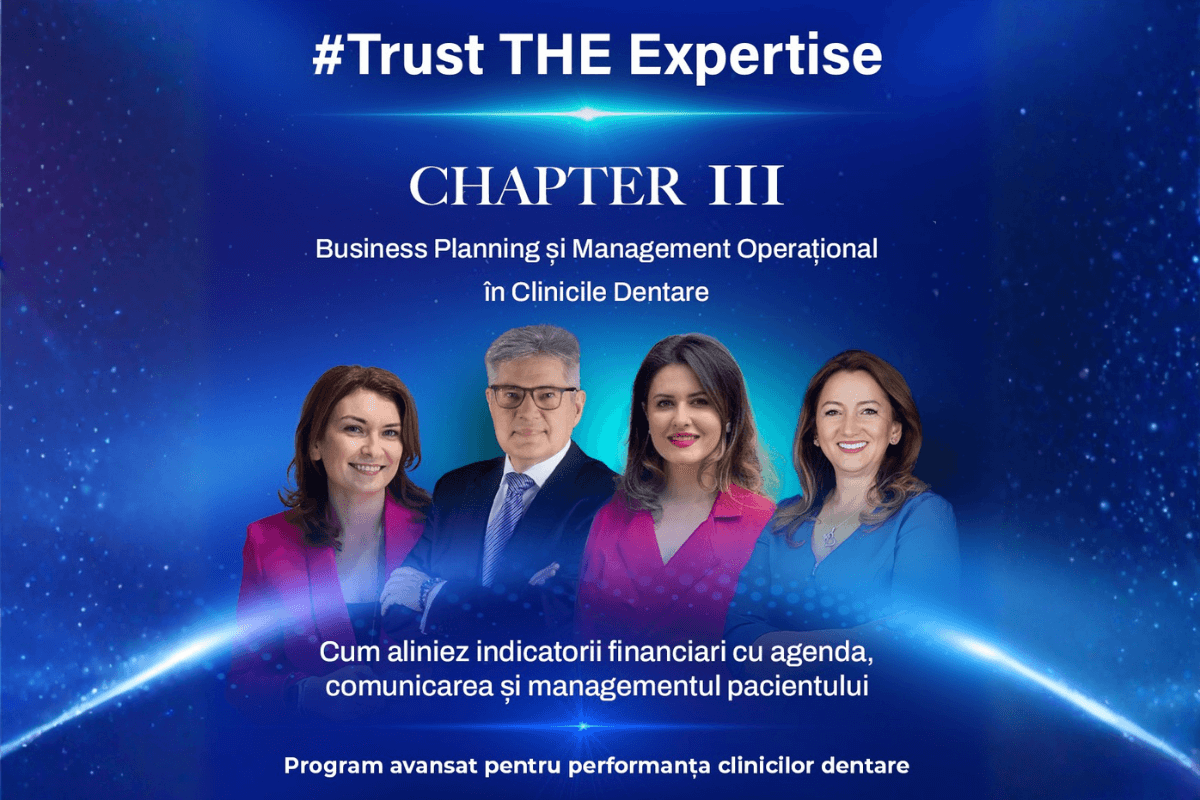
Chapter III: Business Planning and Operational Management in Dental Clinics
Built on this solid foundation of real-world experience, Chapter III translates the lessons learned from DENT ESTET’s development into a structured, practical educational framework. This course provides participants with clear tools for organizing, planning, and scaling dental clinic operations efficiently.
CHAPTER III is designed for professionals who understand that the success of a dental clinic depends not only on clinical excellence, but also on how daily operations are structured and managed. The course offers a clear, structured, and practical approach to clinic management—viewing the clinic as a complex system where processes, people, and performance indicators must be continuously aligned.
Why operational management is the foundation of a successful dental clinic
The reality of dental clinics: a constantly changing environment
Daily operations in dental clinics are often influenced by external factors that are difficult—or impossible—to control: legislative changes, economic fluctuations, staff shortages, patient behavior, rapid technological advancements, unexpected crisis situations.
In this context, the ability to respond quickly and adapt effectively becomes an essential management skill.
Why fast results are not enough for a sustainable dental business
While short-term results are important, a sustainable medical business cannot rely on them alone. Long-term growth requires: solid strategic planning, structured operational systems, clear processes and relevant KPIs. Without these, growth becomes fragile and difficult to sustain.
Operational management: the system that keeps teams aligned
Effective operational management provides stability, predictability, and control—essential for making informed decisions, even under pressure. In dental clinics, this is even more critical due to the need to manage multiple dimensions simultaneously:
- clinical responsibility and quality of care;
- coordination of multidisciplinary teams;
- patient experience throughout the treatment journey;
- continuous adaptation to new technologies and protocols.
Without structured planning and coherent operational management, both financial performance and patient experience can suffer.
Effective operational management also plays an essential role in maintaining a united, prepared team permanently aligned with the organization’s goals.
When processes are clear, roles well-defined, and performance indicators understood by everyone, the team functions in a common language. Everyone knows what to do, why it matters, and how it contributes to the clinic’s goals—without needing repeated explanations or time-consuming realignments.
Why systems make the difference in times of crisis
In unpredictable situations or during crises, this alignment makes the difference between chaos and the ability to react quickly and coherently. A well-built operational system allows the team to make correct decisions even under pressure, adjust workflows without disruption, and continue providing quality services to patients.
At the same time, operational management reduces confusion, internal tension, and the risk of conflicts, providing a stable framework where people can focus on what truly matters. Business planning and operational management directly support team health through:
- predictability in daily activities;
- clarity in roles and responsibilities;
- confidence in processes and direction.
People perform better when they understand the direction, have clear benchmarks, and feel part of a structured system—not a reactive environment.
In a demanding and constantly evolving medical field, this organizational stability becomes essential for: team retention, consistent performance, and building a strong organizational culture.
By aligning business goals with operational reality, CHAPTER III supports both financial growth and the development of mature, accountable, and resilient teams.
What participants learn in Chapter III
Participants are guided by experienced trainers to understand how to build effective operational management—from structuring patient flow and scheduling systems to understanding their direct impact on productivity and patient experience.
From patient flow to performance indicators
The course covers essential topics such as: the role of the first visit in building long-term patient relationships, the importance of internal protocols in reducing errors and team friction, aligning operational decisions with KPIs and business objectives.
Patient communication and treatment acceptance
A key component of the course focuses on improving patient communication and increasing treatment acceptance rates. Participants are introduced to practical psychological frameworks that help teams adapt communication styles based on patient profiles—creating trust-based, clear relationships between patients and medical teams.
Applied learning through workshops and case studies
The practical component—supported by workshops and case studies—allows participants to apply concepts immediately and adapt them to their clinic’s reality from the very next day.
Operational systems built from real DENT ESTET experience
One of the major differentiators of the program is that the entire curriculum is based on real-life experience from DENT ESTET clinics. Topics covered include: patient flow optimization, team restructuring, implementation of internal protocols, productivity optimization, adaptation to unexpected situations. Participants gain access to tested, proven solutions that can be implemented immediately.
This approach has helped build strong, stable teams within DENT ESTET—teams that have grown not only in size, but also in maturity, accountability, and performance. This organizational stability has translated directly into better patient experiences—defined by consistency, clarity, and long-term relationships.
Over more than two decades, DENT ESTET’s experience has shown that well-structured operational systems are a key pillar of resilience in any medical organization.
Chapter III Trainer Team
The course is delivered by professionals with direct experience in managing and developing dental clinics:
- Andreea Necula, Operations Director, DENT ESTET – expertise in team coordination and process optimization
- Bianca Radu, Patient Experience Coordinator & Psychologist – expertise in communication and patient relationships
- Bianca Iacob, Commercial Director & ADOM Trainer – operational management and performance development
- Cristian Taban, Executive Director, DENT ESTET – strategic business vision and financial performance
Who is Chapter III for?
This course is designed for:
- Dental Office Managers who want to move from daily task management to strategic operational leadership
- Operations managers and team leaders seeking clear systems for workflow optimization and team alignment
- Dental clinic owners who want to better understand the relationship between operations, patient experience, and long-term profitability
- It is also ideal for professionals aspiring to management roles who want to build a strong foundation of skills.
Through its applied content and perspective grounded in the reality of dental clinics, the program addresses all those who feel the need for structure, clarity, and concrete tools to run medical businesses with more confidence and coherence.
The DENT ESTET leadership perspective on operational management
CHAPTER III represents a major step in the evolution of how dental clinics operate—offering participants not only updated, relevant knowledge, but also a structured way of thinking that supports better decisions, aligned teams, and sustainable results.
“In a context where clinical excellence is the foundation of a successful clinic, operational management becomes a true differentiator. CHAPTER III provides the framework to transform daily activity from a series of tasks into a clear, coherent, and predictable system that supports long-term performance.”
– Dr. Oana Taban,
Founder & CEO, DENT ESTET
“CHAPTER III is about turning good intentions into systems that work. Participants learn how to build realistic business plans, align financial goals with schedules, teams, and operational KPIs, and make data-driven decisions. Operational management becomes a real growth tool: more clarity, aligned teams, and a predictable clinic.”
– Cristian Taban,
Executive Director, DENT ESTET